
How to Search Winona County Traffic Court Records
Traffic citations and related district-court cases are searchable through Minnesota Court Web Payment when the issue is payment, and through MCRO when the issue is the court case itself. The Judicial Branch says payment access may not open until up to seven days after the citation date, so a brand-new ticket is not always ready for online payment on day one. Once the citation clears processing, WebPay can find or pay a citation or case, including by phone payment if needed.
The first thing to gather is the citation number, case number, or driver name from the ticket or notice. If the ticket is still fresh, the safest move is to wait for the processing window to close before expecting the Court Payment Center to help. If the case has already moved into District Court, the court record will show hearings, disposition, and any fine or warrant events that are public.
The official payment guidance starts here: Minnesota Judicial Branch pay-fines page.
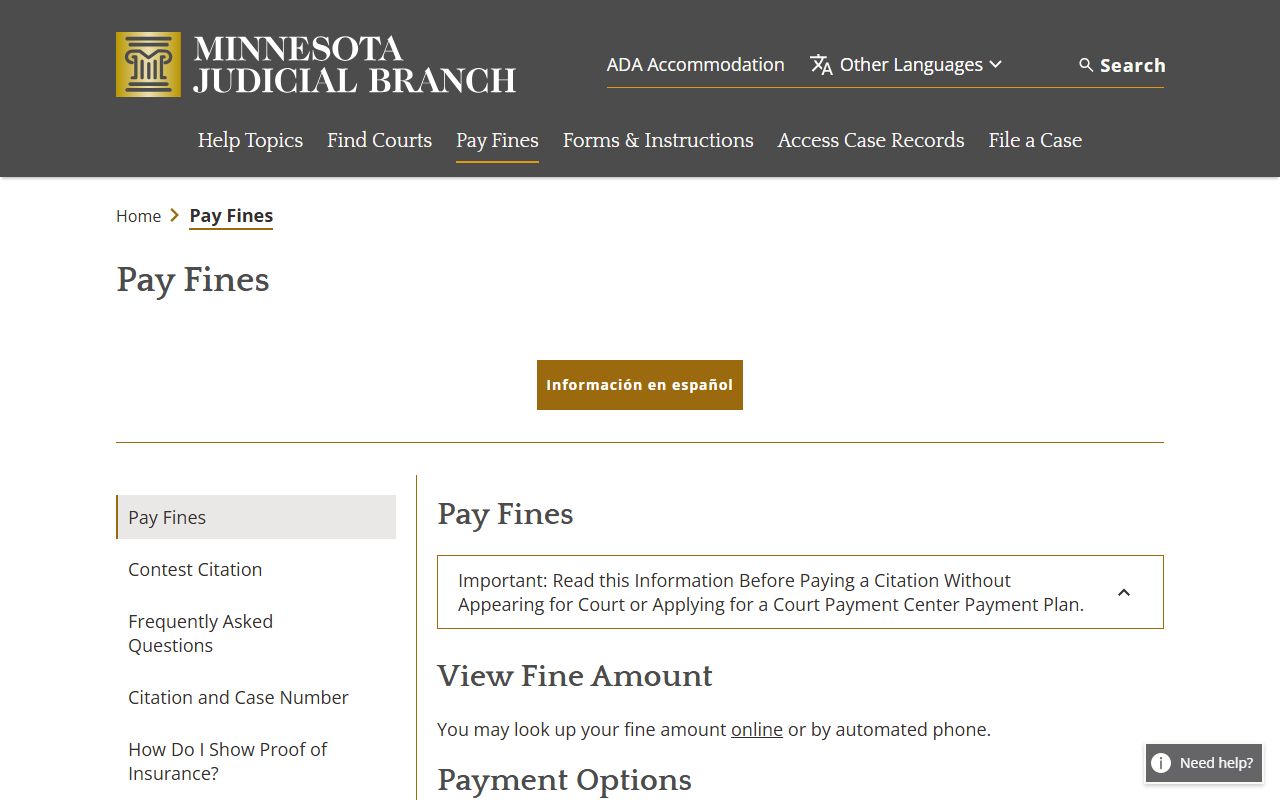
The pay-fines page is the best place to check the seven-day timing rule before assuming a citation is ready for payment or contest options.
- Open WebPay or the pay-fines page and choose citation or case search.
- Enter the citation number, case number, or name as shown on the notice.
- Wait out the processing window if the citation is too recent.
- Review the public case details, payment status, or hearing information.
- Use the court file, the payment portal, or Court Administration to finish the next step.
Which Offices Handle Traffic Cases in Winona County
Winona County does not use a separate municipal traffic court system. The District Court handles traffic cases filed in the county, and the statewide citation system handles payment and phone payment. DVS is separate again, because a driver record is not the same as the court case file. That split matters when a reader has a ticket in hand and is trying to decide whether to look at the court calendar, pay the citation, or request a driving record.
For courthouse traffic matters, start with Winona County District Court at the courthouse. For money on a ticket, use WebPay. For a license history or certified driving record, use Driver and Vehicle Services. The offices work on connected parts of the same event, but each office holds a different record.
| Court or system | Traffic role | How to reach it |
|---|---|---|
| Winona County District Court | Hears traffic cases filed in Winona County and keeps the court file. | 171 W. Third Street, Winona, MN 55987, (507) 615-5183. |
| Minnesota Court Web Payment | Finds or pays citations and cases after processing. | https://webpay.courts.state.mn.us/ |
| Driver and Vehicle Services | Holds the state driver record, not the court case. | DVS Record Request form and mailing process. |
Types of Traffic Cases on Record
Winona traffic matters often show up as violations bureau entries, petty traffic citations, or criminal cases depending on the charge and the way the case was filed. The court calendar shows VB case numbers alongside CR and PR matters, which is a useful clue that the county traffic workflow is mixed into the District Court calendar instead of sitting in a separate traffic courthouse. DWI and some serious driving offenses leave the traffic lane and become criminal cases, while routine citations usually stay in the traffic or violations path.
- Moving violations - Speeding, lane violations, stop-sign violations, and similar tickets usually stay in the citation or violations path.
- Non-moving violations - Equipment or paperwork issues can show up as court citations even when no crash is involved.
- Parking or local ordinance matters - If the matter is handled through court, it may appear as a local citation or violations case.
- Commercial and CDL matters - Commercial drivers often need the court file and the state driving record side by side because the consequences are not limited to the ticket itself.
- DWI and related driving crimes - These usually move into criminal court and may also trigger ignition interlock or license consequences.
What Winona County Traffic Court Records Show
A traffic court file is the court's history of the ticket or charge. It can show the citation number, the charging statute, the hearing date, the disposition, and any payment or warrant event that became public. A court record can also show whether the matter was dismissed, continued, paid, or resolved after a plea. When the case is on the calendar, the hearing type and courtroom are usually more helpful than the driver record because they show where the file stands inside the court system.
| Field | What It Shows |
|---|---|
| Citation number | The ticket identifier used for payment and case lookup. |
| Charge or statute | The traffic law or ordinance cited in the case. |
| Court date | The scheduled hearing date, if the matter is set for court. |
| Disposition | How the case ended, such as paid, dismissed, continued, or convicted. |
| Fine amount | The amount due or paid if the court assessed a financial penalty. |
| Points assessed | State driver consequences if the disposition was reported to licensing authorities. |
Searching by Citation Number vs by Name
Citation number searches are the cleanest option when the ticket is in hand because they avoid name collisions and usually point straight to the correct payment or case record. Name searches help when the citation number is missing, but they can produce more than one match if a person has several traffic matters or if the spelling varies. A date of birth or case number can narrow that search when the portal allows it. The county calendar is a useful cross-check because it shows the case type and hearing date even when the payment portal is not enough by itself.
| Search field | Type | Required | Notes / format |
|---|---|---|---|
| Citation or case number | Text | Yes | Best field for direct payment or lookup. |
| Citation number | Text | Conditional | Statewide citation number is often a 12-digit preprinted number. |
| Last name | Text | Conditional | Use when the citation number is not available. |
| Date of birth | Date | No | Useful for narrowing a name search. |
| Phone payment | Phone | No | (651) 281-3219 or (800) 657-3611. |
Paying or Contesting a Winona County Traffic Ticket
When a ticket is ready for payment, the statewide portal is here: Minnesota Court Web Payment.
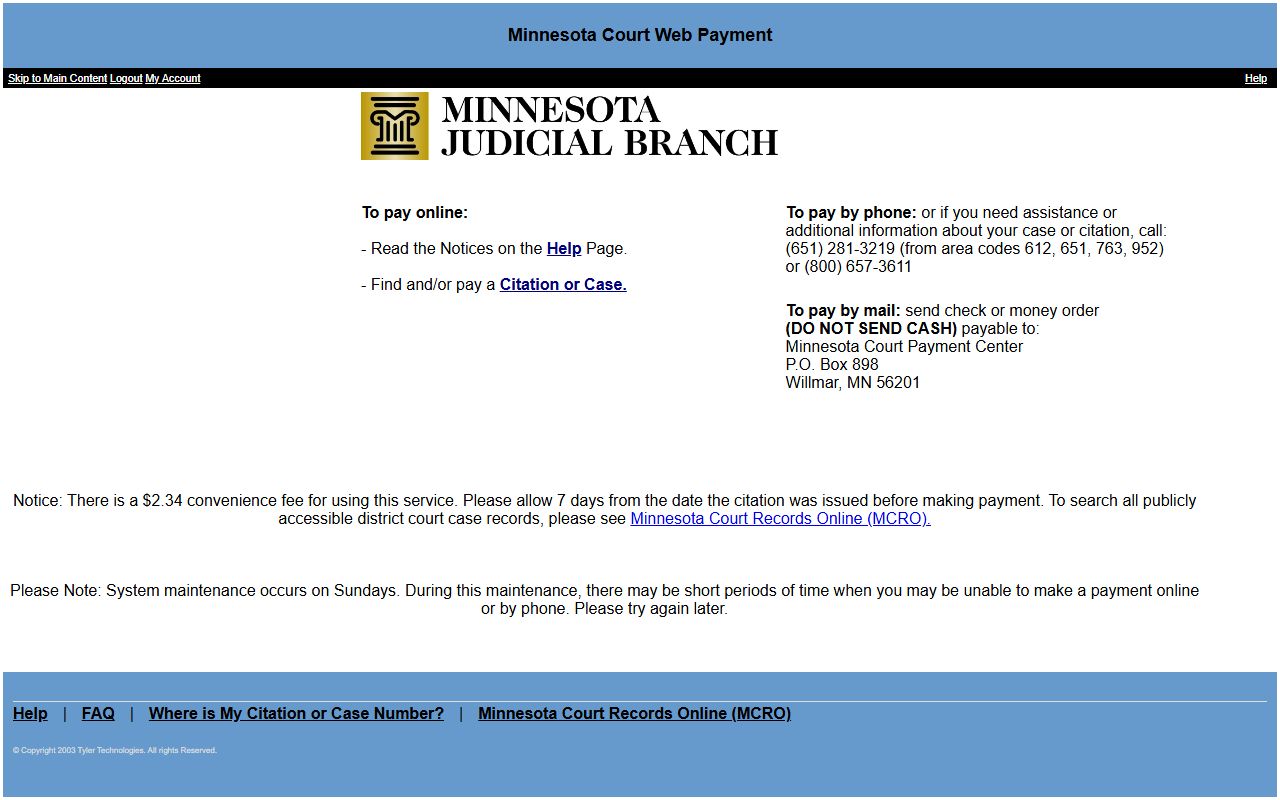
That portal is the payment side of the process. It is not the court file itself, and it does not replace District Court when a person needs a hearing date, a disposition history, or a certified copy. If the citation is too new, the court says to allow the processing time first. If the issue is a no-insurance or proof-of-insurance citation, proof should be provided before payment decisions are made.
Contesting a ticket is different from paying one. A payment usually ends the case the way the citation allows, while a contest means the matter stays in the court system until a hearing or other court action resolves it. If a driver has already missed a court date, the case may move toward a warrant or another enforcement step rather than a simple payment screen.
- Wait until the citation is ready for online handling if it is brand new.
- Use WebPay or the payment center to review the amount due.
- Check whether the citation requires proof of insurance or another document before payment.
- If contesting, follow the court instructions for a hearing or plea instead of paying first.
- If the court file has already moved beyond a basic citation, contact Court Administration at the courthouse.
Public Access Rules for Traffic Court Records
Traffic court records are public unless a rule or order makes them restricted. Minnesota's public-access rules control what can be seen online and what has to be viewed at the courthouse. MCRO is the official online window into many district-court records, but the records shown there are unofficial and are not certified copies. Court Administration is the office that can certify a copy if the record qualifies.
The main access rules sit in the public-access rule set and the Minnesota Government Data Practices Act. For the court record, the important question is not just whether the case exists, but whether the public can see it remotely, whether the document is public, and whether a certified copy must come from the courthouse. For a driver record, the question changes to DVS access and the request form used by Driver and Vehicle Services.
Key rules: Minn. R. Pub. Access 8 governs remote inspection, copying, and bulk distribution for court records, while Minn. Stat. §13.03 governs general access to government data outside the court record.
Court Traffic Records vs State Driver Records
The WebPay portal is the quick check for a ticket that may already be in the payment window, but it does not replace a DVS request when the question is the state driver history. When the court file and the driver record answer different questions, the safest route is to read both before making a payment or filing a records request.
The court file and the driver record are separate records. The court file shows the case, the charge, the hearing, and the disposition. The driver record shows the licensing side, including driving history and the state record that DVS maintains. A person who needs to know whether a case was paid, continued, or set for court usually wants the court file first. A person who needs a certified driving history for licensing or employment purposes usually wants the DVS record instead.
| Record type | Source | What it shows | How to access |
|---|---|---|---|
| Court traffic record | Winona County District Court | Charge, hearing, disposition, fine, warrant or failure-to-appear events if public | MCRO, WebPay, or Court Administration |
| State driver record | Driver and Vehicle Services | Driving history, license record, and state driving-related entries | DVS Record Request form |
That distinction matters because the driver record can be expensive and may need a mailed request, while the court file may be available through MCRO or at the courthouse with a much different fee structure. If a citation is still pending, the court file is the better starting point. If the matter has already been reported to licensing, the driver record tells the later licensing story.
For DVS requests, the form asks for the driver's name, date of birth, Minnesota DL or ID number, the specific record details, and whether the requester is the subject of the data. Mailed requests go to Driver and Vehicle Services Records Unit, 445 Minnesota St., Suite 161, St. Paul, MN 55101-5161, and the packet must include a legible ID copy or notarized signature with check or money order payment.
CDL and Commercial Driver Records
Commercial drivers have less room for error because traffic convictions can ripple into the commercial record even when the court case itself looks routine. A CDL holder often needs both the court record and the DVS record to see the full effect of a citation. The court file tells what happened in Winona County District Court. The DVS record tells what made it to the state driver history. When a citation involves a commercial vehicle, the safest move is to keep both records separate and read both before deciding what to do next.
If the citation is serious enough to become a criminal matter, the traffic page is no longer the right record set. The charge belongs with the criminal case file, and the related history is better handled through the criminal records page at Arrest Records & Charges.
DUI / DWI Cases
DUI and DWI matters usually leave the ordinary traffic lane and become criminal court cases. That means the court file is filed, calendared, and searched with the criminal case record rather than with a simple citation lookup. Winona County also points defendants and readers toward district-program guidance such as ignition interlock when the driving privilege part of the case matters.
For the criminal case record, hearings, pleas, and sentencing history, use the county criminal records page instead of the traffic payment screen. The right place to start is Winona County arrest and charge records.
Deferred Adjudication and Similar Traffic Outcomes
Traffic matters can resolve in more than one way. Some end in a payment, some in dismissal, and some in a court appearance that changes the charge or the outcome. A deferred or alternative resolution, when allowed, usually affects the court file and may also affect the state driving record. The key is to confirm the exact case type first because traffic, violations bureau, and criminal cases do not all follow the same path.
If the file is still in District Court and the reader needs the hearing trail, MCRO and the calendar are better than a payment screen. If the result is already entered, the disposition in the court record is what matters most, not the original ticket wording.
Sealing or Expunging Traffic Records
Traffic records are not all treated the same way when a person asks to seal or expunge them. Some traffic-related matters sit inside the criminal expungement chapter, while others remain governed by the public-access rules unless a court order changes the access status. The practical question is whether the case is a simple citation, a criminal driving offense, or a matter already sealed by order.
When sealing is possible, the court process matters more than the ticket itself. The court record can be limited or hidden from public view, but that is a legal result, not an automatic online change. The correct route is the court file, the applicable rules, and the clerk or court administrator who can explain what copy can be certified.
Fees for Traffic Record Copies and Driver Records
Winona County's fee schedule is the better source for court copies than a generic state summary because it shows the local law-library add-on and the copy fees that apply through District Court Administration. DVS has a completely separate fee structure for driver records, and that fee usually depends on whether the requester is the subject of the record and whether the copy is certified. The county fee table is the right place to verify the local copy, certification, and filing amounts before paying anything online.
The local court fee table is here: Winona County District Court fees.
The DVS record form is here: Minnesota DVS Record Request Form.
| Item | Amount |
|---|---|
| Certified copy of civil or criminal instrument | $14 |
| Exemplified and certified copy | $28 |
| Report copy, 1-50 pages | $5 |
| Report copy, 50+ pages | $25 per 50 pages or part |
| Uncertified copy of a public imaged or e-filed document viewed in the courthouse | $0 |
| Court Web Payment convenience fee | $2.34 |
| DVS non-certified driving record | $9 if requester is subject, $9.50 if not |
| DVS certified driving record | $10 if requester is subject, $10.50 if not |
| DVS issuance-date letter | $10 if requester is subject, $10.50 if not |
Those DVS fees are for the state driving record, not the court case. The local court copy prices stay with District Court Administration, while the driver's record request follows the DPS mailing process and the separate fee schedule from Driver and Vehicle Services.